

If you have ever driven down MoPac during rush hour or taken a casual cruise down RM 2222, you already know that Central Texas highways are essentially horizontal gravel pits. Between the loose limestone flying off the back of construction dump trucks and the rogue road debris spinning off semi-truck tires, your car’s factory paint job is fighting for its life out there.
When you start researching ways to shield your investment, Paint Protection Film (PPF) inevitably becomes the gold standard. But as you dig into the technical specs, one fundamental question keeps popping up: how thick is ppf?
It is a straightforward question with a surprisingly fascinating answer. Many car enthusiasts assume that protecting a vehicle requires a thick, bulky armor plate reminiscent of a military vehicle. The reality is a masterpiece of modern chemical engineering. The film is incredibly thin nearly microscopic compared to traditional protective materials yet it manages to absorb impacts that would easily shatter your factory clear coat. Let’s pull back the layers on how film thickness actually works, how it is measured, and what it means for your car on Austin roads.

The Anatomy of Micro-Armor: Understanding the Layers
To truly understand film thickness, we have to talk about how it is measured. In the automotive styling and protection industry, thickness is calculated in a unit known as a mil. A mil is equal to one-thousandth of an inch (0.001 inches). To give you a relatable point of comparison, a standard human hair is roughly 3 to 4 mils thick, and a typical plastic grocery bag sits at about 1 mil.
When people ask how thick is ppf, the industry baseline for a premium, high-tier film is right around 8 mils.
That 8-mil total thickness is not just a single solid sheet of plastic. Instead, it is a highly engineered, multi-layered sandwich where every single stratum has a specific functional job to perform:
- The Release Liner (Discarded): This is the defensive backing that protects the film during shipping. It is removed right before installation and does not count toward the final on-car thickness.
- The Acrylic Adhesive Layer (~1.1 to 1.5 mils): This is the high-tack engineering fluid that bonds the film permanently to your vehicle’s curves. It is formulated to fill in microscopic paint imperfections while remaining completely optically clear.
- The Polyurethane Core (~6.0 mils): The true muscle of the operation. This heavy-duty thermoplastic polyurethane (TPU) is what absorbs the impact energy of a flying rock, stretching and dispersing the force so the paint underneath remains entirely untouched.
- The Self-Healing Top Coat (~0.5 to 0.7 mils): The magical outer shell. This low-surface-energy layer features elastomeric polymers that rearrange themselves when exposed to heat, causing light swirl marks and washing scratches to vanish completely in the Texas sun.
How Thick is PPF Compared to Your Car’s Factory Paint?
A common misconception among Austin drivers is that modern factory automotive paint is thick and durable. Unfortunately, environmental regulations over the past few decades have forced automotive manufacturers to transition from heavy, lead-based solvent paints to water-borne paint systems. While these modern paints are far better for our environment, they are notoriously thin and brittle.
A standard factory paint job on a modern luxury vehicle or electric vehicle generally measures between 3.5 to 5.5 mils thick. That measurement includes the primer, the base color coat, and the final clear coat altogether.
Think about those numbers for a moment. At roughly 8 mils thick, a high-quality paint protection film is nearly twice as thick as the entire factory paint job it is designed to protect. When an airborne rock strikes your front bumper, it is hitting an energy-absorbing barrier that completely dwarfs the delicate clear coat beneath it. It provides a sacrificial cushion that handles the kinetic energy of road debris without transferring that force to the metal or carbon fiber body panels.
Striking the Perfect Balance: The Problem with Extra Thickness
If 8 mils is excellent, why don’t manufacturers simply produce 15-mil or 20-mil films to give your sports car bulletproof levels of protection? It seems logical on the surface, but thickness comes with severe installation and aesthetic trade-offs.
[Too Thin: < 6 mils] ──────> High Clarity ───> Zero Rock Protection
[Perfect Zone: 8 mils] ───> Flawless Finish ───> Maximum Impact Absorption
[Too Thick: > 12 mils] ─────> Rigid Material ──> Bubbles & Lifting Edges
As a film gets thicker, the underlying polyurethane core becomes increasingly rigid and stiff. A film that is too thick lose its elasticity, making it virtually impossible to wrap cleanly around the complex compound curves of a modern performance bumper, side-mirror cap, or aggressive hood line. Forcing an overly thick film onto these complex shapes causes deep tension lines, stretch marks, and lifting edges where the adhesive simply cannot fight the memory of the rigid plastic.
Furthermore, excessive thickness degrades the optical properties of the film. An 8-mil premium film is entirely invisible, allowing the depth, flake, and metallic luster of your factory paint to shine through perfectly. If you cross into extreme thickness territories without specialized engineering, you introduce a milky, orange-peel texture that noticeably dulls the visual clarity of your car’s finish.
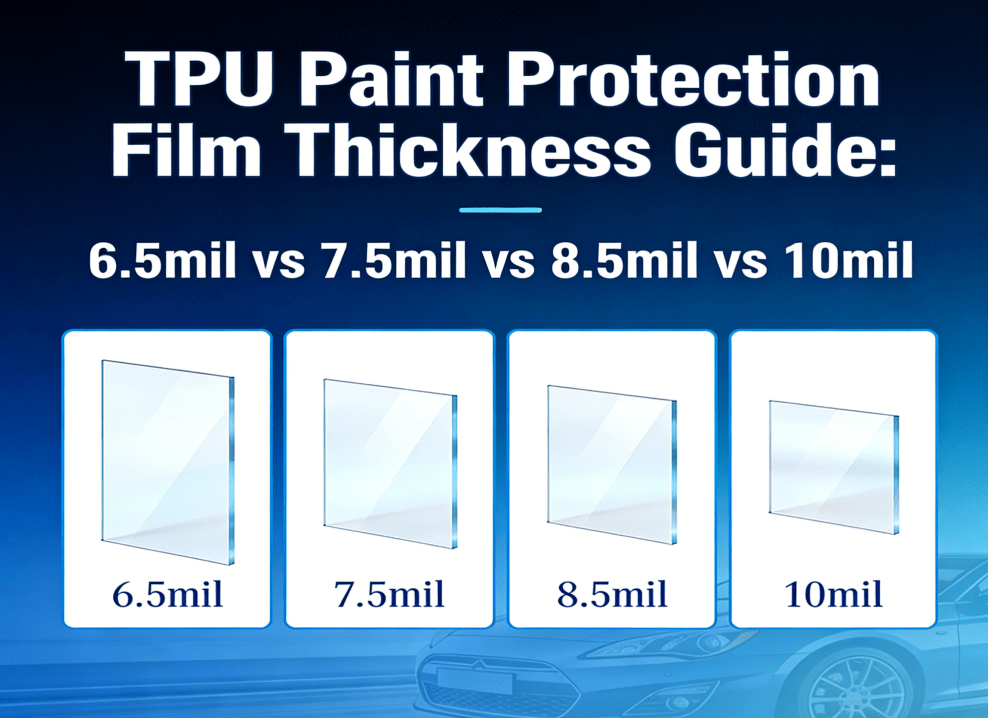
PPF Thickness Variations at a Glance
| Film Tier Classification | Average Thickness | Primary Use Case and Application Zone |
| Standard/Optimum Film | 7.5 to 8.5 mils | Complete vehicle wraps, high-impact front clips, daily road debris protection |
| Heavy-Duty/Track Film | 10 to 12 mils | Off-road rocker panels, lower track splitters, extreme commercial use |
| Lightweight/Interior Film | 4 to 6 mils | Interior gloss black plastic trims, infotainment screens, center consoles |
The Austin Climate Factor: Why Quality Thickness Matters Globally
The environmental conditions in Central Texas subject automotive films to extreme stress. The intense UV radiation we experience during long summer months rapidly degrades low-grade, thin films. It causes them to turn yellow or become brittle. Cheap films often thin out their polyurethane cores to cut production costs. This design leaves the adhesive layer to bear the brunt of the sun’s heat. The intense heat causes the adhesive to break down, which leaves a sticky, ruined mess on your clear coat if you ever remove the film.
According to technical standards verified by international testing bodies like ASTM International, premium polyurethane films must maintain structural integrity under prolonged thermal exposure. They must do this without losing their elastomeric properties.
At Austin Auto Lab, we select advanced, field-proven films that balance precise thickness with pristine optical clarity. This engineering ensures excellent performance whether you commute down Interstate 35 or navigate loose gravel on a hill country backroad. Your film behaves exactly as intended. It remains completely invisible while acting as a reliable shield against the elements.

Protect Your Ride with Austin’s Precision Experts
Understanding the physics of film thickness is only half the equation. The real magic happens during the installation process. Wrapping an 8-mil protective barrier flawlessly around your car requires immense patience, specialized software templates, and years of physical handling experience. These skills ensure edges remain completely tucked and seamless.
Do not wait for that first definitive impact on the highway to realize your clear coat lacked protection. Bring your vehicle to a team that understands the exact science of paint preservation.
Contact Austin Auto Lab today to get a custom quote and discover how our advanced paint protection film installations can keep your car looking showroom-fresh for years to come.